A driveway has a demanding job. It carries vehicles every day, frames the front of your property and needs to cope with Melbourne’s changing weather without becoming a maintenance headache. When weighing up a concrete vs pavers driveway, the best choice is rarely just about the initial quote. Site conditions, drainage, vehicle use, design goals and the standard of installation all matter.
For some properties, a well-finished concrete driveway is the practical, clean-lined answer. For others, pavers offer the character and repair flexibility that make more sense over time. Understanding where each surface performs best will help you invest with confidence.
Concrete vs pavers driveway: the key differences
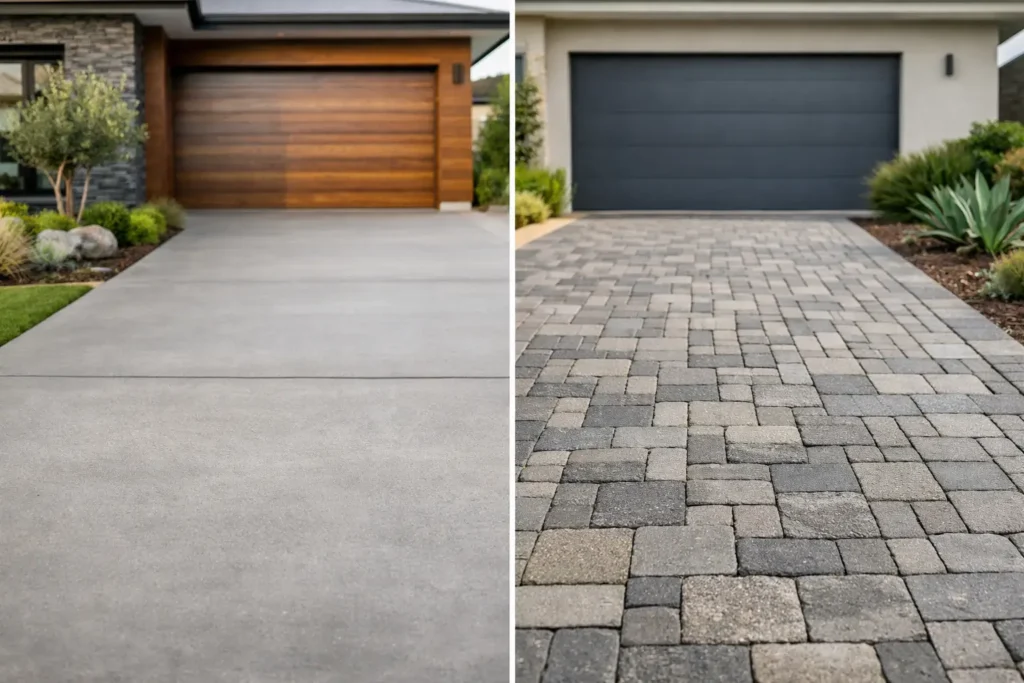
Concrete is poured as a continuous slab over a prepared base, then finished in a chosen texture and colour. Standard broom-finished concrete remains popular for its grip and value, while exposed aggregate offers a more decorative look and can complement brick, render and modern façades.
Pavers are individual units laid over a compacted base and bedding sand, with edge restraints holding the driveway together. They are available in concrete, clay and natural stone options, with a wide range of sizes, laying patterns and colours.
The central difference is simple: concrete creates one solid surface, while pavers create a flexible system of smaller components. That affects cost, movement, drainage, repairs and the finished appearance.
Upfront cost and long-term value
For a straightforward driveway with good access and minimal excavation, plain concrete is often the more economical option upfront. It is quicker to place across larger areas and has fewer individual components to lay. Decorative finishes such as exposed aggregate, coloured concrete, saw-cut patterns and borders will increase the price, but can still deliver a strong result for a front-yard upgrade.
Pavers usually cost more at the outset because of the additional labour involved in base preparation, laying, cutting and finishing edges. Premium clay or stone pavers can raise the budget further. However, the higher initial spend can be worthwhile when the driveway is a major design feature or needs to tie into existing paths, retaining walls, garden edging or a heritage-style home.
Long-term value is not simply about the cheapest square metre rate. A driveway that drains correctly, suits the property and is built on a properly compacted base is less likely to require expensive attention later. A low initial quote can become poor value if it leaves out excavation, drainage provisions, reinforcement, edge restraints or suitable base material.
Ask what is included in the quote
When comparing driveway proposals, make sure each quote covers the same scope. The surface itself is only one part of the job. Preparation may involve removing an existing driveway, excavating unsuitable soil, compacting crushed rock, creating falls for water runoff, installing drainage and reinstating surrounding landscaping.
For concrete, clarify slab thickness, reinforcement, control joints, finish and curing process. For pavers, ask about the base depth, compaction, edge restraints, jointing sand and how cuts around drains or curves will be handled. These details are where durable driveways are made.
Durability under everyday vehicle use
A professionally installed concrete driveway can last for decades. It handles regular cars, family SUVs and light commercial vehicles well when the slab thickness and reinforcement are appropriate. Concrete is particularly suited to broad driveways, clean geometric layouts and properties where a continuous, low-fuss surface is preferred.
Its limitation is that concrete is rigid. Melbourne properties can have reactive clay soils, and ground movement can lead to cracking over time. Control joints are designed to manage where concrete cracks, but they do not eliminate the possibility of visible movement-related cracks. Tree roots, poor drainage and heavy vehicles can also cause damage if the driveway has not been designed for those conditions.
Pavers can accommodate minor ground movement more effectively because joints sit between the individual units. A small amount of settlement may show as a local dip or uneven area rather than a crack running across the whole surface. Provided the base remains sound, affected pavers can often be lifted, the bedding corrected and the same units relaid.
That does not mean pavers are maintenance-free. If the base is poorly compacted or edge restraints fail, pavers can move, spread or become uneven. Driveways carrying regular delivery vehicles, boats, caravans or heavier utes need a base and paver selection designed for the load, not a standard pedestrian paving build-up.
Drainage is a deciding factor
Water is one of the biggest reasons driveways deteriorate. It can undermine a base, stain surfaces, cause puddling and direct runoff towards a garage or house. The driveway should be graded so water moves to an appropriate drainage point, while complying with local requirements for crossovers and stormwater management.
Concrete is impermeable, so every drop runs across the surface. This makes correct falls essential. In some layouts, a channel drain near the garage or at the bottom of a slope is needed to prevent water entering the building.
Traditional pavers are not automatically permeable, but their joints can allow some water through. Permeable paving systems go further, using specific pavers and open-graded layers beneath to manage stormwater. They can be a useful option where drainage is difficult or where reducing surface runoff is a priority, although they require careful design and installation.
If your block slopes, sits below the road, has known drainage issues or is close to mature trees, address these factors before choosing a surface. The right driveway material cannot compensate for poor water management.
Appearance, kerb appeal and design flexibility
Concrete suits homeowners who want a neat, contemporary finish with fewer visual breaks. Exposed aggregate is especially popular across Melbourne because it provides texture, natural colour variation and good traction. It works well beside artificial grass, crisp garden beds, timber features and modern fencing.
Pavers offer more pattern, texture and detail. They can soften a large expanse of hard surface, create a formal entry and provide a closer match to period homes or established gardens. Herringbone patterns are often chosen for driveways because they interlock well under vehicle traffic, while larger-format pavers can give a more modern result when properly specified.
Think about the entire frontage rather than viewing the driveway in isolation. The colour of the roof, brickwork, fence, paths and planting should influence the final selection. A dark surface may look striking but can show dust, tyre marks and leaf litter more readily. Pale finishes can brighten a narrow frontage but may reveal stains. Samples viewed outdoors, in changing light, are more reliable than choosing from a small showroom swatch.
Repairs and ongoing maintenance
Concrete is generally easy to maintain. Regular sweeping, occasional pressure cleaning and prompt treatment of oil stains will keep it looking presentable. Sealing exposed aggregate or decorative concrete can help protect the finish and make cleaning easier, although sealers need reapplication over time.
The downside comes when concrete cracks, sinks or is badly stained. Small cracks can be repaired, but colour matching and making repairs disappear completely is difficult. Significant damage may require cutting out and replacing a section, which can remain visible.
Pavers need periodic sweeping and, depending on the site, topping up jointing sand. Weeds can establish in joints when organic material builds up, but this is manageable with routine cleaning and appropriate treatment. Individual stained, chipped or sunken pavers can be replaced with far less visual disruption than a concrete patch, particularly if spare pavers have been kept from the original project.
For low-maintenance priorities, concrete usually has the edge. For repairability and future access to underground services, pavers are often more forgiving.
Which driveway is right for your property?
Choose concrete if you want a cost-effective, continuous surface, have a straightforward layout and prefer minimal routine upkeep. It is a strong choice for modern homes, wide driveways and projects where exposed aggregate can lift kerb appeal without the cost of detailed paving.
Choose pavers if visual character, flexible repairs or minor ground movement are key concerns. They are also worth considering where the driveway needs to blend with existing paving, curved paths or a more traditional landscape style.
The best result starts below the surface. Before committing, assess soil conditions, existing drainage, vehicle loads, access, crossover requirements and how the driveway will connect with the rest of the landscape. An experienced landscaping team can coordinate those details from excavation through to surrounding garden works, rather than treating the driveway as a stand-alone slab or paved area.
A driveway should make arriving home easier, improve the presentation of the property and continue performing after years of use. Select the material that suits your site and lifestyle, then give equal attention to the groundwork that supports it.