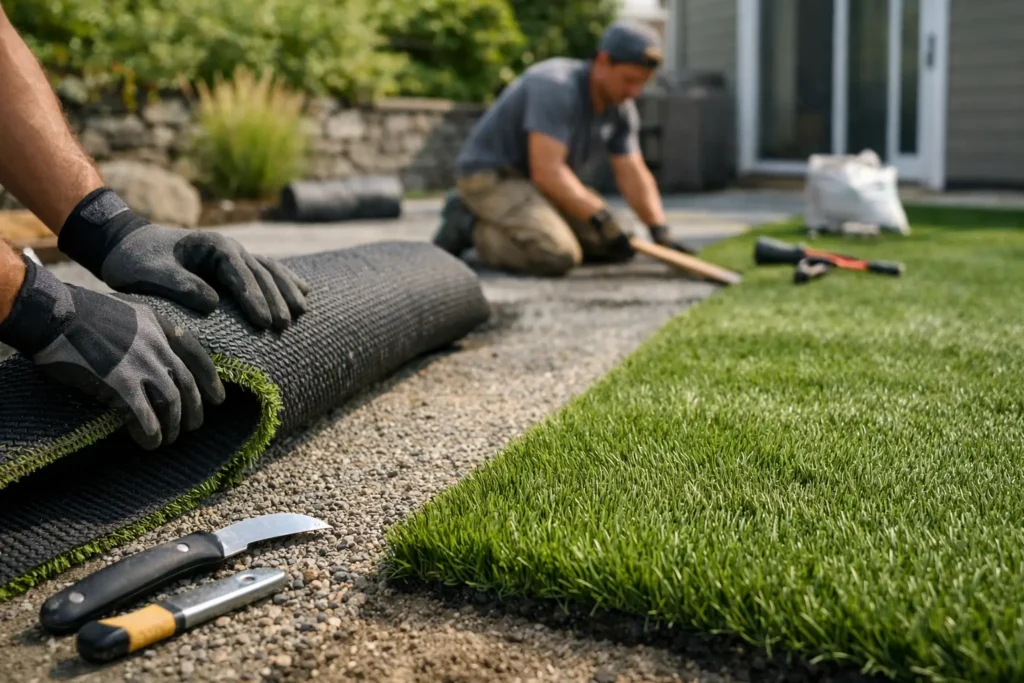
A roll of artificial grass can make the job look simple. Cut it, roll it out, pin it down, done. In reality, when people ask is it hard to install artificial grass, the honest answer is this: laying the turf itself is not usually the hard part. Getting the base, drainage, levels and joins right is where the work really sits.
That matters because artificial grass is only as good as what is underneath it. If the ground prep is rushed, even premium turf can end up looking uneven, holding water or lifting at the edges. If the preparation is done properly, the finished result looks neat, feels firm underfoot and lasts for years with very little fuss.
Is it hard to install artificial grass for a DIY project?
It depends on the site, your tools and your expectations.
For a small, flat area with clear access, no drainage issues and a simple shape, a capable DIYer can install artificial grass successfully. If you are replacing a tidy patch of lawn in a courtyard or a narrow side yard, the process is manageable with patience and the right materials.
For larger areas, sloping blocks, awkward edges, curved garden beds, pet zones or commercial spaces, the difficulty rises quickly. The heavier the excavation, the more precise the levelling, and the more cutting and seaming involved, the less forgiving the job becomes.
That is why some installations look fantastic and others look obviously artificial. The difference is rarely the turf alone. It is usually the workmanship underneath.
What makes artificial grass installation hard?
The challenge starts before the turf arrives. Existing grass, weeds, roots and topsoil need to be removed to the right depth. If too little is excavated, the finished height can sit awkwardly above paving, edging or drains. If too much is removed and not rebuilt properly, the surface can feel soft or dip over time.
Then there is the base. A proper crushed rock or road base layer needs to be spread, levelled and compacted so the surface is stable. This is one of the most important parts of the job and one of the easiest to get wrong. A base that looks level by eye can still have low spots, poor falls or weak sections that show up later.
Drainage is another common sticking point. In Melbourne conditions, heavy rain can expose poor preparation quickly. Artificial grass is porous, but the water still needs somewhere to go. If the sub-base is compacted incorrectly or the falls do not direct water away properly, you can end up with pooling, odours or soggy patches.
Cutting and joining the turf also takes more skill than many people expect. Straight cuts need to stay clean, joins need to disappear into the pile, and the grain of the grass must run the same way across the whole area. If it does not, the lawn can look patchy even when the product itself is high quality.
The part most people underestimate
Compaction is the part many DIY installers underestimate.
A base can look smooth after a rake-over, but unless it is compacted correctly in layers, it may shift once people start walking on it. You might not notice the problem on day one. A few months later, however, you can start seeing footprints, depressions near the edges, or a lawn that no longer sits neatly against surrounding hardscape.
This is where experience makes a real difference. Professional installers know how different sites behave, how much material is needed, and how to build the base for long-term performance, not just a tidy handover photo.
When DIY can work well
DIY installation can be a sensible option if the project is small, access is easy and you are comfortable using compaction equipment and doing careful set-out work. A straightforward rectangle with timber or concrete edging is far easier than a space full of curves, stepping stones, drains or garden features.
It can also work when appearance is not the only priority. If the area is tucked away, used lightly and you are happy with a practical finish rather than a polished one, doing it yourself may offer acceptable value.
That said, DIY savings can disappear if the base material is wrong, the turf is damaged during cutting, or you need to redo sections after rain. The material cost is still significant, so mistakes are not always cheap.
When professional installation is usually worth it
If you want the lawn to look sharp from every angle, sit neatly against surrounding surfaces and stay that way, professional installation is usually the safer choice.
This is especially true for front yards, family backyards, rental properties, schools, childcare areas, display homes and commercial spaces where presentation matters. In these settings, visible joins, loose edges or uneven levels stand out straight away.
Professional installation is also worth serious consideration if your site has existing drainage issues, poor access, tree roots, pets, heavy traffic or a noticeable slope. Those are the jobs where experience saves time and prevents expensive rework.
For many property owners, the real value is not just labour. It is confidence that the full system has been installed properly, from excavation and base prep through to the final brush and clean-up.
Is it hard to install artificial grass on different surfaces?
The surface underneath changes the difficulty.
On natural soil, the main challenge is excavation, weed control, compaction and drainage. On old paving or concrete, the issue becomes drainage, adhesion, height transitions and whether the existing surface is suitable in the first place. On uneven ground, every problem becomes more noticeable because the artificial grass will follow poor contours unless they are corrected below.
Installing around pools, decks, retaining walls or feature gardens also adds complexity. Clean detailing matters in these spaces. A rough edge or lumpy finish can take away from the entire landscape.
Common mistakes that make the job harder later
A rushed installation often looks acceptable at first. The problems usually appear after use or after weather events.
The most common mistakes are weak base preparation, poor drainage falls, incorrect joining, skimping on edge fixing and choosing the wrong turf for the space. Pet areas, for example, need more thought around drainage and cleaning. High-traffic play zones need a stable, well-compacted foundation. Decorative areas may need a different pile height and finish to look natural beside planting and paving.
Another mistake is treating artificial grass as a standalone product instead of part of the wider landscape. Levels should work with adjoining paths, garden edging, irrigation points and runoff. When the whole space is planned together, the result looks cleaner and functions better.
What the installation process usually involves
A proper installation normally starts with site inspection and measuring. After that, the area is excavated, cleared and shaped. A base material is brought in, spread and compacted to create a firm, even platform with the right falls for drainage.
A weed barrier may be added depending on the system and site conditions. The turf is then rolled out, left to settle, trimmed carefully and joined where needed. Once fixed in place, the surface is brushed up and checked for finish, edge security and consistency.
None of those steps are mysterious, but each one affects the final result. That is why artificial grass can be quick in theory and surprisingly technical in practice.
So, is it hard to install artificial grass?
For the average property owner, it is moderately hard – not because the concept is complicated, but because the quality of the result depends on precision. The labour can be physical, the base work needs to be accurate, and small errors become very visible once the turf is down.
If you are handy, have the right equipment and are working on a simple area, it may be a realistic DIY project. If you want a premium finish, have a complex site, or simply do not want to risk redoing the job, professional installation is often the better investment.
At Australian Landscape Hub, we see this decision point often with Melbourne homeowners and property managers. Most are not asking whether turf can be laid. They are asking whether it will still look level, drain properly and hold up well in a year or three. That is the right question to ask.
A good artificial lawn should look easy once it is finished. Getting it to that point is where the real work happens, and choosing the right approach at the start will save you time, money and frustration later.