A well-planned screen can turn a backyard that feels exposed into a private, usable outdoor room. The best plants for privacy screening are not simply the fastest growers at the nursery. They need to suit your available space, soil, sunlight, desired height and willingness to maintain them – particularly in Melbourne, where hot dry spells, winter cold and heavy clay soils can all influence performance.
A dense living screen also does more than block a neighbour’s view. It can soften fencing, reduce visual clutter, create a greener outlook from inside the home and provide shelter for outdoor entertaining areas. The right choice is one that looks good in year two and still fits the property in year ten.
Start with the screen you actually need
Before choosing a plant, decide what the screen must achieve. A low boundary planting may only need to reach 1.5 metres, while overlooking from a double-storey home may call for a taller screen positioned closer to the viewing point. Planting a very tall hedge where a modest screen would work often creates unnecessary trimming, shade and root competition.
Measure the planting strip as well as the desired height. Many hedges are sold in small pots but spread substantially as they mature. A narrow side passage needs upright plants with restrained roots and foliage that can be maintained within the boundary. A larger rear garden can accommodate a broader, more natural-looking hedge.
Also consider whether privacy is needed all year. Evergreen foliage is generally the practical choice for screening around patios, pools, front gardens and commercial boundaries. Deciduous trees can provide summer shade, but they are rarely reliable as a stand-alone visual barrier through winter.
Best plants for privacy screening: reliable Melbourne choices
Lilly pilly
Lilly pilly remains one of the most popular choices for residential privacy screens, and for good reason. It is evergreen, responds well to clipping and can create a thick green wall relatively quickly when planted, watered and fed properly. Modern varieties bred for resistance to psyllid are worth considering, as this pest can cause puckered leaves on more susceptible types.
Different lilly pillies have very different mature sizes. Compact forms can suit lower hedges, while taller cultivars are effective for screening up to several metres. They prefer reasonable drainage and regular watering while establishing. In tight planting beds, give them enough room to develop rather than forcing plants into a line that becomes overcrowded and thin at the base.
Clumping bamboo
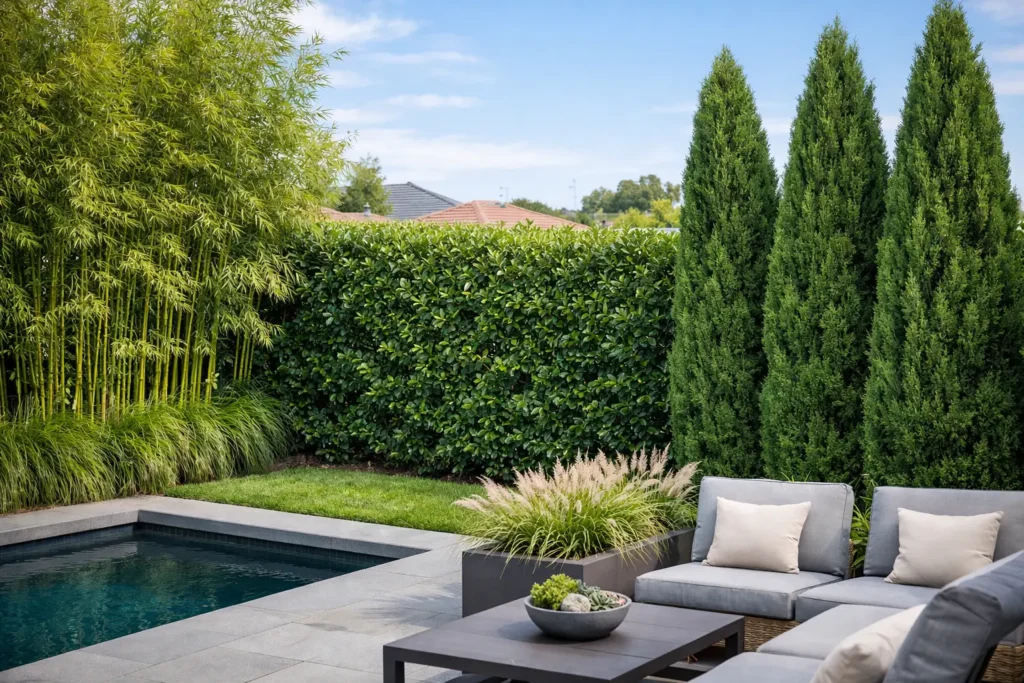
For a narrow strip where height is essential, clumping bamboo can be an excellent option. Unlike running bamboo, true clumping varieties stay contained around their original root mass and produce tall, upright canes with fine foliage. They are particularly useful beside contemporary fences, around pools and along side boundaries where conventional hedges would become too wide.
The trade-off is water. Bamboo can look lush and provide quick cover, but it needs a dependable irrigation system during hot weather, especially in its first few summers. Choose the species and cultivar carefully, allow for its mature width, and avoid assuming every bamboo is safe to plant near a boundary. Correct identification matters.
Sweet viburnum
Sweet viburnum is a strong-performing evergreen hedge for larger properties and wider garden beds. Its broad leaves produce dense coverage, it tolerates a range of conditions and it can be clipped into a formal hedge or allowed to grow more naturally. The foliage creates a substantial screen that suits family backyards, driveways and commercial sites.
It is not the best fit for every small courtyard. Left untrimmed, sweet viburnum becomes large, and a narrow bed will soon make maintenance difficult. Give it room, install irrigation where practical and prune regularly from an early age to encourage density all the way down to ground level.
Callistemon and other native screens
Native plants can provide privacy without making a garden feel overly formal. Bottlebrush varieties, including upright callistemons, offer evergreen foliage and vibrant flowers that attract birds. They are a practical choice for homeowners who want a screen with a more distinctly Australian character and better tolerance of local conditions once established.
For lower screening, westringia is another dependable native option. Its grey-green foliage is well suited to dry, exposed positions and regular shaping. It will not provide the same tall, solid barrier as bamboo or lilly pilly, but it works well along front boundaries, driveways and garden edges where a neat screen around one to two metres is enough.
Photinia
Photinia is valued for its fresh red new growth, which brings colour to a hedge without relying on flowers. It can make an attractive medium-height screen in a sunny position and responds well to regular trimming. Its foliage is broad enough to create privacy, while the red flush gives a more decorative finish than a plain green hedge.
It does need airflow. In damp, crowded or heavily shaded positions, photinia can be more prone to leaf spot. Good plant spacing, sensible pruning and avoiding overhead watering help keep the foliage healthier. It is best suited to owners prepared to undertake seasonal maintenance rather than those seeking a completely hands-off screen.
Pittosporum
Pittosporum offers an upright, tidy look and is commonly used for architectural gardens and tighter urban blocks. Varieties with narrow leaves or columnar habits can create useful screening without taking over a path or patio. Their clean form works especially well alongside timber fencing, paving and modern hardscaping.
The main consideration is exposure. Some pittosporums can struggle in severe frost pockets or on harsh, windblown sites. In Melbourne’s outer northern suburbs, assess the microclimate before planting. A protected courtyard may be ideal, while an open, cold boundary may need a tougher selection.
Design decisions that make a hedge look better
Plant choice is only part of the result. A screen looks fuller when the planting bed has been properly prepared, the plants are set out at the right centres and the soil is improved with compost or suitable organic matter where needed. Heavy clay should be addressed before planting, not after roots have stalled in wet ground through winter.
Planting density is a balancing act. Close spacing may create quicker coverage, but cramming plants together can lead to competition, weak growth and disease. The recommended spacing depends on the species, pot size and intended finished hedge. A professional landscape plan accounts for the mature plant, not just the bare fence line on installation day.
For a more natural result, consider a layered screen where space allows. A taller hedge or small tree canopy at the rear, combined with lower shrubs and groundcovers in front, gives depth and reduces the appearance of a single clipped green wall. It can also create better habitat and visual interest across the seasons.
Establishment and maintenance matter
Even hardy plants need attentive care during establishment. Deep watering encourages roots to grow down into the soil, while frequent shallow watering keeps roots near the surface and makes plants more vulnerable in dry weather. Drip irrigation is often the most efficient solution for long hedge lines because it delivers water directly to the root zone.
Apply mulch after planting, keeping it clear of stems and trunks. A 50 to 75 millimetre layer helps retain soil moisture, moderates temperature and suppresses weeds. Check mulch levels each year, particularly around new screens where weeds can compete strongly for water and nutrients.
Pruning early is the secret to a dense hedge. Waiting until plants reach full height before trimming usually produces a screen that is bare or open near the bottom. Light, regular trims encourage side branching. Keep the hedge slightly wider at the base than the top so lower foliage receives enough light and remains healthy.
Avoid selecting a plant purely because it promises rapid growth. Fast growth can mean frequent pruning, heavy water demand or a mature size that overwhelms the site. A slower, well-matched screen often provides the better long-term outcome and lower maintenance cost.
When plants are not enough on their own
A new hedge takes time to close gaps. If privacy is urgent, combine planting with a suitable fence extension, timber battens, decorative screening or a pergola. Climbers can soften these structures, but they also need support and ongoing pruning. This approach delivers immediate privacy while plants establish and gives the landscape a more finished appearance from day one.
For properties with difficult slopes, drainage issues, poor soil or overlooking from several angles, a coordinated landscape design is especially valuable. Australian Landscape Hub can assess the site, recommend plants suited to its conditions and integrate screening with irrigation, retaining walls, paving or decking where required.
The most effective privacy screen is one that belongs in the garden rather than fighting it. Choose plants for their mature shape, resilience and maintenance needs, then give them the soil preparation and early care they need to become a lasting green boundary.