
A beautiful new lawn, paved entertaining area or garden bed can quickly become a costly headache if water has nowhere safe to go. This outdoor drainage design guide explains how Melbourne property owners can plan for runoff before it damages foundations, saturates turf, erodes soil or leaves standing water across hard surfaces.
Drainage is not an add-on to landscaping. It shapes the levels of the site, the materials that will perform well, the location of garden beds and the long-term condition of every outdoor feature. A well-planned system is often barely visible, yet it protects the parts of your property that matter most.
Start with how water moves across your property
The first job is to understand the natural fall of the block. Water follows gravity, but on many established properties that path has been interrupted by extensions, driveways, retaining walls, garden edging and neighbouring development. A backyard may appear flat while still holding water in one low corner, or a front yard may send runoff directly towards the house after a heavy downpour.
Walk the property during rain where possible, or inspect it soon afterwards. Look for puddles that remain after the rest of the ground has dried, washed-out mulch, muddy tracks, moss on paving, water marks against walls and turf that feels soft underfoot. These are useful clues, not minor cosmetic issues.
The roof is part of the picture too. Gutters, downpipes and roof catchments collect a large volume of water quickly in Melbourne’s changeable weather. If a downpipe discharges beside a garden bed or onto paving without a considered outlet, it can overwhelm an otherwise sound landscape.
A drainage plan should also consider surrounding levels. Water must not be redirected onto a neighbour’s property or allowed to undermine boundaries. For commercial and industrial sites, vehicle movements, loading areas and public access routes need particular attention, as ponding water creates both surface damage and slip risks.
Outdoor drainage design guide: establish levels first
Correct levels are the foundation of effective drainage. Before laying pavers, installing synthetic turf, building a deck or placing a retaining wall, the finished height of each element needs to be mapped out. This determines where water will flow and where drains, pits or channels need to sit.
Hard surfaces should generally fall away from buildings so surface water is directed towards a suitable collection point. The exact gradient depends on the material, area and site conditions, but the principle remains simple: water should move steadily without creating an obvious slope that compromises comfort or appearance.
Garden areas need a different balance. They should hold enough moisture for plants while allowing excess water to drain through the soil profile. Raising a garden bed can help in a wet location, but it does not solve drainage if water is trapped behind edging, retaining walls or dense clay beneath the soil.
On sloping blocks, retaining walls are often necessary to create usable space. They also need drainage behind them. Without a drainage aggregate layer, agricultural pipe and a safe discharge point, water pressure can build behind the wall. Over time, this may lead to staining, movement, cracking or failure.
Match the system to the problem
There is no single drain that suits every yard. The best solution depends on the source of the water, the volume being managed, soil type, available fall and the approved place for water to discharge.
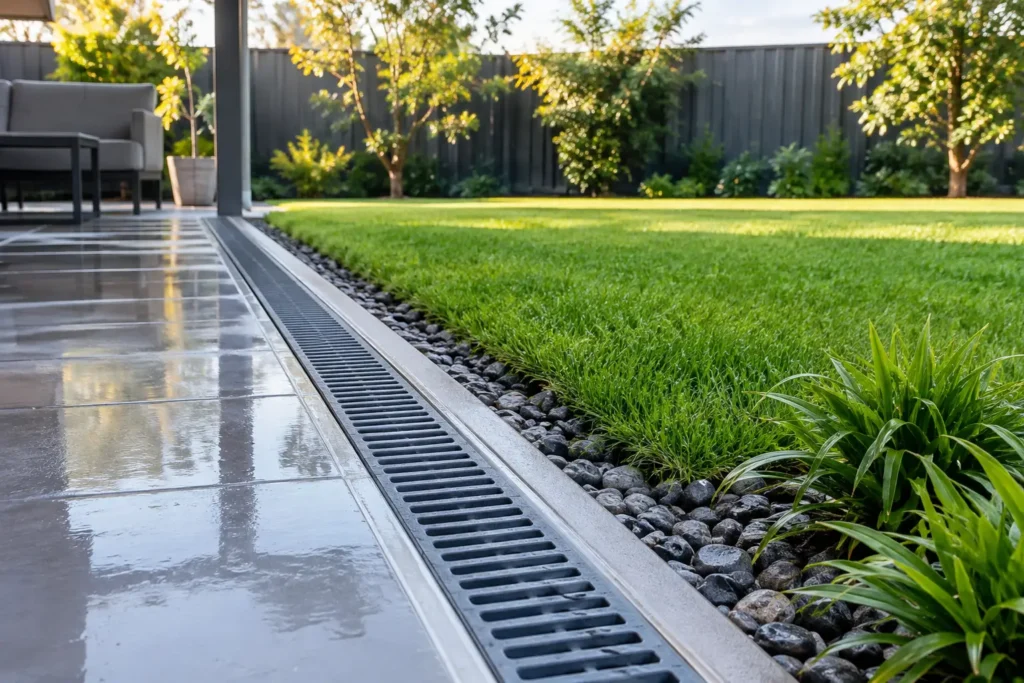
Surface drains are suitable where runoff travels across paving, driveways or concrete. A narrow channel drain along the edge of an alfresco, garage entrance or driveway can intercept water before it enters a building or pools where people walk. Grates should be strong enough for their expected use and easy to lift for cleaning.
Subsoil drainage is designed for water moving through the ground. Perforated drainage pipe, usually surrounded by clean aggregate and wrapped in geotextile fabric where appropriate, collects excess moisture beneath lawns, garden beds and behind retaining walls. It is particularly valuable in parts of Melbourne with reactive clay soils, where drainage can be slow after sustained rain.
Spoon drains and swales use gentle, shaped surface levels to guide runoff through a landscape. They can be practical in larger front yards, commercial verges and open gardens where a visible grate would be unnecessary. Done well, they look like part of the landscape rather than a drainage installation.
Rain gardens and detention areas can slow and filter water where there is enough space and the design suits local requirements. They are not simply holes filled with plants. They need engineered layers, suitable species and overflow arrangements so they function in both light rain and heavy events.
For many properties, the strongest outcome combines several methods: correct paving falls, connected downpipes, a surface drain in a high-risk area and subsoil drainage where the soil remains wet.
Plan drainage with paving, turf and planting
Every landscape material changes how rain behaves. Impervious surfaces such as concrete, porcelain pavers and compacted paths shed water quickly. The more of these surfaces a property has, the more carefully runoff must be collected and directed.
Permeable paving can reduce surface runoff, but it still requires a properly designed base and edge restraint. It is not a shortcut around drainage planning. Fine sediment, leaf litter and poor installation can reduce permeability over time, so maintenance must be considered from the start.
Natural turf needs a stable, free-draining base and appropriate grading. If water sits on turf, the grass can thin out, compact and become muddy. Artificial grass also needs drainage beneath it. While the surface itself does not absorb water, its base must allow rainfall to pass through and disperse without creating wet, uneven patches.
Plant selection matters as well. Plants that tolerate occasional wet conditions can be useful near drainage lines or low points, while species that require dry roots should be kept away from areas that collect water. Mulch helps protect soil, but overly thick mulch can obstruct shallow drainage paths and wash into pits during storms.
Do not overlook discharge and maintenance
A drain only works if the water it collects has a lawful, functional destination. Depending on the property and local requirements, this may be a legal point of discharge, an approved stormwater connection, a suitably designed onsite system or another compliant option. This stage should never be guessed, especially where new structures, large paved areas or significant changes to ground levels are involved.
Access is equally important. Drain grates, pits and inspection points should be positioned where they can be cleaned without pulling apart a garden or lifting major sections of paving. Leaves, mulch, soil and rubbish can block even a well-designed system.
A practical maintenance routine is straightforward: clear gutters and grates before the wetter months, remove sediment from pits, check that downpipe connections remain secure and watch for new ponding after alterations to the garden. If a drain begins backing up, act early rather than waiting for water to reach a building.
When professional design makes the difference
Small surface issues may be solved with modest regrading or a localised drain. However, professional input is worthwhile when water is reaching the building, a retaining wall is planned, a driveway is being rebuilt, the block has poor fall, or drainage changes could affect neighbouring properties.
An experienced landscaping team can coordinate drainage with excavation, concreting, paving, turf, planting and retaining works so the finished landscape functions as one complete system. This avoids a common mistake: installing attractive features first, then trying to retrofit drainage around them later.
For homeowners, property managers and businesses across Melbourne’s north-west, Australian Landscape Hub can assess site conditions and build drainage into a tailored landscape plan from the outset. The aim is not to fill a yard with visible grates and pipes. It is to create an outdoor area that stays usable, protects the property and still looks right in every season.
The best time to resolve water problems is before the next landscape upgrade. Begin with the fall of the land, give every drop a deliberate path, and the rest of the design will have a far better chance of lasting.